Bodyweight vs Free Weights: How to Decide Where to Start
Bodyweight vs free weights isn’t really a competition — both build real strength. The better question is what you have access to right now and how much time you want to spend on technique before you start adding load.
Bodyweight vs free weights: when bodyweight comes first
If you’re new to structured training, bodyweight work lets you learn how a movement should feel before a barbell or dumbbell adds another variable. Squats, push-ups, and rows against your own bodyweight teach the same joint positions and muscle recruitment patterns you’ll use later with external load, without the added risk of a heavy bar in an unfamiliar position. It’s also the practical choice if you don’t have equipment, travel often, or train in small spaces.
The tradeoff is that bodyweight training eventually runs out of easy ways to add difficulty. Once a bodyweight squat or a standard push-up stops being challenging, you’re working with tempo changes, single-limb variations, or added range of motion rather than a simple weight increase.
When free weights start to pay off
Free weights solve the progression problem directly — you can add a small amount of load at a time, which makes it easier to keep challenging a muscle group once bodyweight versions feel too easy well before fatigue sets in. They’re also close to necessary for certain goals, like building pulling strength through rows and deadlift-style movements, since bodyweight pulling options are limited without a bar or suspension trainer.
The tradeoff runs the other way: free weights ask more of your setup, your space, and your attention to form under load, and a mistake with a loaded bar carries more consequence than a mistake with just your bodyweight.
Cost and space are practical factors too. A basic set of adjustable dumbbells or a few resistance bands covers most of what a beginner needs and doesn’t require a gym membership, but it’s still an added expense and something to store, unlike bodyweight training, which asks for nothing beyond a bit of floor space. If you’re working around a joint issue or a past injury, a physical therapist can help you figure out which loading style, or which specific exercises, fit your situation before you commit to either one.
A simple way to decide
If you’re unsure, spend several weeks with bodyweight versions of squats, push-ups, and rows, focusing on control rather than reps. Once those feel comfortable well before fatigue, that’s a natural point to introduce light free weights while keeping the same form cues you already built. This order tends to produce fewer technique problems than starting heavy and trying to fix form later.
Plenty of people end up mixing both permanently rather than graduating from one to the other. A lifter might keep bodyweight push-ups and pull-ups as a warm-up while using dumbbells for the main work of a session, or lean on free weights for lower-body strength while sticking with bodyweight core and mobility work. There’s no rule that says you have to pick one and stay there.
Neither option is required to make progress. General physical activity guidelines focus on consistent movement across a range of formats, not any one method. The best starting point is whichever one you’ll actually keep doing.
Whatever you choose, technique problems get harder to fix once you add weight, not easier — so it’s worth being strict about form before load ever becomes part of the equation.
What the Research Says About Both Methods
It is easy to find strong opinions about whether bodyweight training or free weights is “better,” but the research is more balanced than the debate suggests. Studies comparing push-ups to bench presses at similar effort levels have found comparable muscle and strength gains in the chest and arms, as long as both are performed with progressive overload. The human body does not know whether resistance comes from a dumbbell or from gravity. It only knows tension, and both methods create it.
Where the two differ is in how easily that tension can be adjusted. Free weights let you add small, precise increments: a slightly heavier dumbbell, one more rep, one more set. That makes progressive overload simple and measurable over months. Bodyweight training requires more creativity to progress: elevating your feet, slowing the tempo, moving to single-limb variations, or adding pauses. Both approaches build real strength, but weights make the path more straightforward once basic movement patterns are solid. This is why many trainers treat bodyweight work as the foundation and weights as the long-term engine.
A Practical Decision Framework for Beginners
Instead of asking which method is better in general, ask which is better for you right now. Three practical factors matter more than any study.
Access and consistency
Bodyweight training wins on convenience. You can do it at home, in a hotel room, or at a park with zero equipment and zero commute. If your biggest barrier is showing up, bodyweight removes every excuse. Free weights require either a gym membership or some home equipment, which adds cost and friction. The method you will actually do five days out of seven is the right one to start with.
Your starting point and joint health
Bodyweight exercises are generally gentler on joints because the loads are self-limiting: you cannot load more than your body weight, and awkward positions tend to self-correct. This makes them a smart entry point if you are returning from a break, managing old injuries, or carrying extra weight. If joint comfort is a deciding factor, start with bodyweight and add weights gradually as confidence grows. Our full-body guide at Workout Routine for Beginners at Home shows exactly how to build that foundation with no equipment.
The Hybrid Approach Most Trainers Recommend
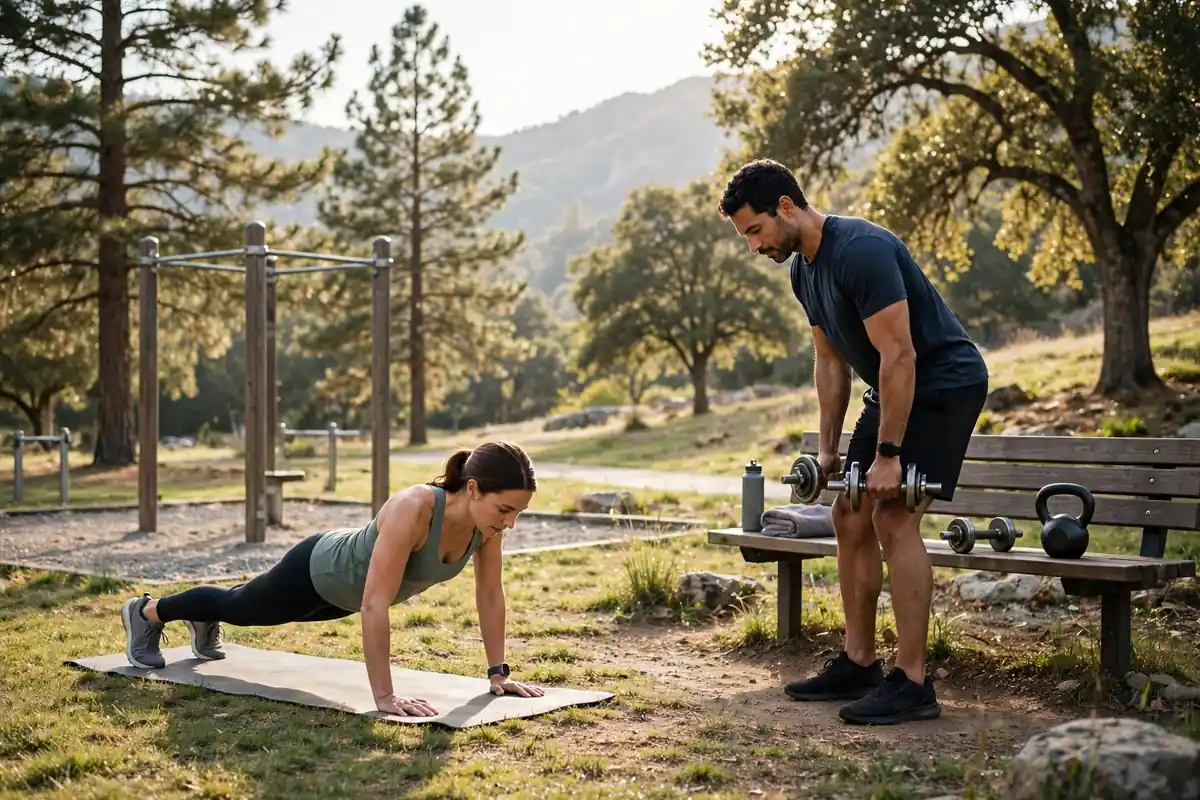
You do not have to choose one forever. A hybrid approach is what most experienced trainers actually practice: bodyweight movements for warm-ups, finishers, and travel workouts, plus free weights for the main progressive strength work. A simple workout schedule for beginners could be two dumbbell sessions focused on compound lifts and one bodyweight circuit for conditioning and core. This combination covers more movement patterns, reduces overuse strain from repeating the same lifts, and keeps training interesting.
When choosing where to train, equipment matters too. If you are deciding between setting up at home or joining a gym, our comparison of home gym vs commercial gym walks through the costs and trade-offs so you can match your setup to your chosen method.
Frequently Asked Questions
Can I build muscle with bodyweight exercises alone?
Yes, especially as a beginner. Push-ups, squats, lunges, planks, and pull-up progressions build meaningful muscle when performed with enough volume and taken close to fatigue. Advanced trainees eventually hit a ceiling where adding external weight becomes the simplest way to keep progressing.
Is it safer to start with bodyweight or free weights?
Bodyweight is usually the safer starting point because the loads are lighter and self-limiting. That said, light dumbbells with good form are also very safe. The real risk with weights comes from adding load before mastering the movement pattern, not from the weights themselves.
How long should I train with bodyweight before adding weights?
A common rule of thumb: once you can perform the basic bodyweight versions with clean form for solid sets, you are ready. That might be 10 controlled push-ups, 15 bodyweight squats, and a 30-second plank. There is no strict timeline, and you can also start both in parallel with light loads.
Do I need a gym to use free weights effectively?
Not necessarily. A pair of adjustable dumbbells or a kettlebell at home covers most beginner and intermediate needs. A gym becomes more valuable later, when you need heavier loads, barbells, and machines for variety.
Which is better for weight loss: bodyweight or free weights?
Both support weight loss when paired with sensible eating, because both preserve muscle while you are in a calorie deficit. Higher-intensity bodyweight circuits may burn slightly more calories per session, while weights build more muscle long term, which supports your metabolism. Consistency matters far more than the choice.
Conclusion
The bodyweight versus free weights debate has a simple answer for beginners: start with whichever you will do consistently, master the basic movement patterns, and combine both over time. Bodyweight training is the lowest-barrier entry point and teaches the control every lifter needs. Free weights provide the clearest path for long-term progression. For a broader look at building lasting activity into your life, see the National Institute on Aging’s guide to exercise and physical activity, and explore more training guides on the All Day Health & Fitness homepage.