How to Do a Bodyweight Squat Without Hurting Your Knees
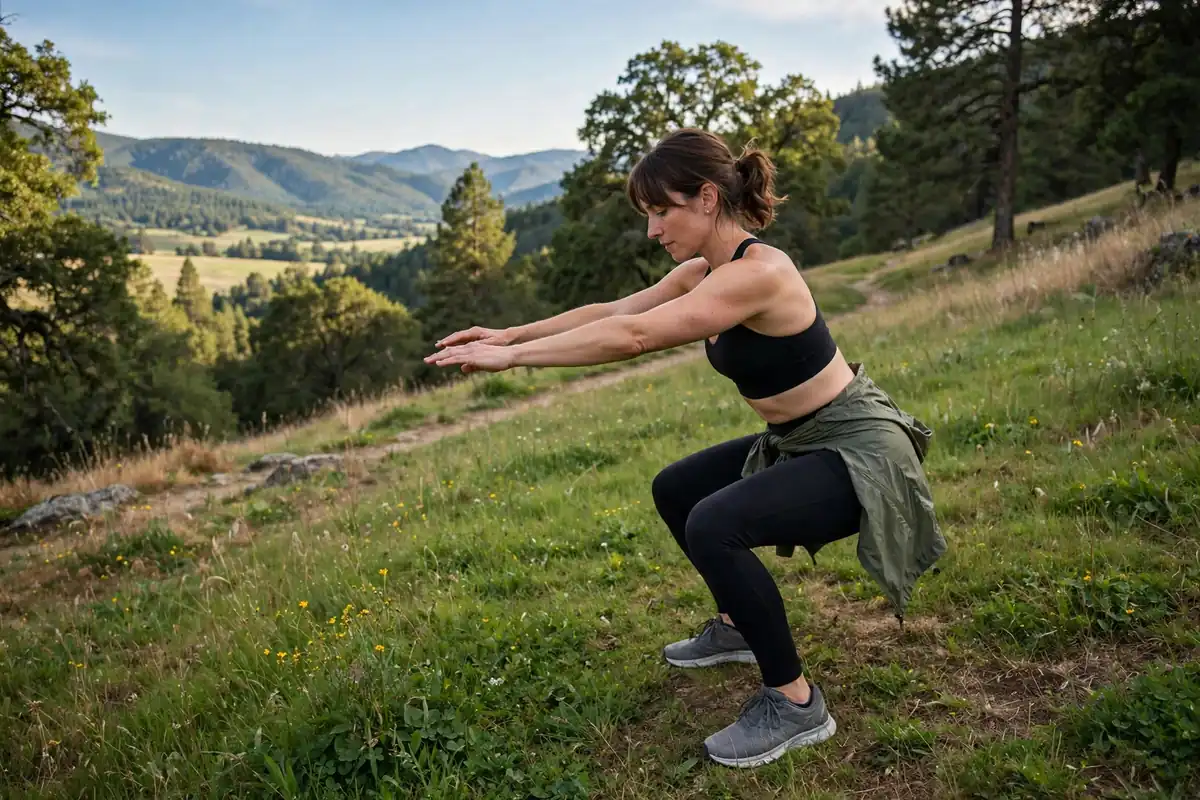
Knee pain during squats almost always comes down to one of three things: how your knees track over your feet, how far you’re bending forward, or how fast you’re moving. Fix those and most bodyweight squat discomfort clears up without changing anything else about your routine.
Where the strain usually starts
The most common issue is letting the knees collapse inward as you lower down, which shifts load onto the inner knee joint instead of the muscles built to handle it. The second is stopping the movement at the knees rather than the hips — pushing the knees forward without sending the hips back means your quads and knee joint absorb weight that your glutes and hamstrings should be sharing.
A cue-by-cue setup
- Stand with feet roughly shoulder-width apart, toes turned out slightly rather than pointed straight ahead
- Start the movement by pushing your hips back, as if reaching for a chair behind you, before your knees bend much at all
- Keep your knees tracking in the same direction as your toes throughout — imagine spreading the floor apart with your feet
- Lower only as far as you can while keeping your heels flat and your lower back in a neutral position, not rounded
- Drive up through the whole foot, not just the toes, and finish with hips fully extended
Depth is individual. Some people can comfortably squat well past parallel with the floor; others feel better stopping higher. Reps-in-reserve is a more useful gauge than a fixed depth or count: stop the set a few reps before your form starts to break down, not when you hit a number.
When it’s more than form
A dull, generalized ache that shows up during the movement and settles once you warm up is common and usually not a red flag. Sharp pain, swelling, a painful clicking sensation, or a knee that gives way is different — that’s worth a conversation with a doctor or physical therapist before you keep loading the joint. A prior injury, surgery, or an existing knee condition is also a good reason to get individualized guidance rather than working from a general guide like this one.
One thing to try this week
Record a short video of your next set from the side. Watching your own hip and knee position is more useful than any cue list, because it shows exactly where your form breaks down under fatigue rather than at rep one. For more no-equipment strength moves like this, the NHS’s guide to gym-free exercises is a solid next stop.
If your knees still bother you after cleaning up form for a couple of weeks, that’s a sign to get it looked at rather than push through.
What Healthy Knees Actually Do During a Squat
The knee is a hinge joint built to bend under load; squatting is one of the most natural things it does. Knee pain during bodyweight squats almost never means squats are bad for knees. It usually means something in the movement is off, the surrounding muscles are not doing their share, or the joint is being asked for more range than it currently has. Understanding what correct looks like makes the fixes obvious.
First, the old rule that your knees must never pass your toes is outdated. For most body types, the knees traveling slightly forward over the toes during a deep squat is normal and safe. What matters far more is tracking: your knees should travel in line with your toes, without caving inward. Knees collapsing inward, called knee valgus, is the most common form fault behind squat-related knee discomfort, and it usually signals weak glutes rather than bad knees. Second, keep your weight balanced across the whole foot. When the weight drifts onto the toes, the knees take more force than they need to; when it stays centered, the hips and glutes share the work properly.
The Step-by-Step Bodyweight Squat
The bodyweight squat belongs in every workout plan for beginners because it trains the fundamental human movement of sitting down and standing up under control. Here is how to do it cleanly. Stand with your feet about shoulder-width apart, toes turned out slightly, roughly 10 to 15 degrees. Before you move, brace your core lightly and think about screwing your feet into the floor to create a stable arch. Start the movement by pushing your hips back slightly, as if reaching for a chair behind you, then bend the knees and lower yourself in one smooth motion.
Descend under control, taking about two seconds to reach the bottom. Keep your chest lifted and your gaze forward, not down at your feet. Let your knees track out over your toes in the same line. Go only as deep as you can while keeping your heels on the floor, your torso relatively upright, and your lower back in its natural curve; for many beginners that is thighs parallel to the floor, and that is a perfectly good squat. Then drive through your whole foot, not just your toes, to stand back up, squeezing your glutes at the top. A short warm-up makes a real difference before squatting: five minutes of easy movement plus some leg swings and bodyweight lunges prepares the hips, knees, and ankles, as our guide on how to warm up before a workout explains.
When to Limit Depth or Try a Modification
If full-depth squats bother your knees, the answer is rarely to stop squatting. It is to squat within the range that feels good while you build the strength and mobility to go deeper. Limiting depth is a legitimate training tool, not a failure.
Knee-friendly modifications that still build strength
The box squat is the best friend of sensitive knees: place a sturdy chair or bench behind you and squat until your glutes lightly touch it, then stand. The box gives you a consistent depth target and removes the fear of going too low. If your heels lift off the floor at depth, ankle mobility is likely the limiter; placing a thin book or a small plate under each heel lets you squat deeper with an upright torso while you work on ankle flexibility separately. Wall sits build quad strength with zero joint movement: slide your back down a wall until your thighs are roughly parallel to the floor and hold for 20 to 45 seconds. And to fix knees caving inward, loop a light resistance band just above your knees during bodyweight squats; pressing out against the band teaches your glutes to keep the knees tracking correctly. Film yourself from the front to check the tracking, using the same self-review approach described in our guide on how to tell if your form is off without a trainer watching.
Red flags that mean stop, not modify
Modifications handle discomfort from form and deconditioning, but some signals mean the joint itself needs attention. Stop and get evaluated if you feel sharp or stabbing pain inside the knee, if the knee swells during or after squatting, if it buckles or gives way, if it locks or catches, or if pain persists for more than a week or two despite good form and lighter training. Pain is information; these particular signals are telling you to see a professional, not to find a cleverer modification. The MedlinePlus overview of exercise and physical fitness gives the same bottom line that applies to all training: stop if something does not feel right and seek help rather than pushing through.
Frequently Asked Questions
Should my knees go past my toes when I squat?
For most people, yes, slightly. Knees traveling a bit forward over the toes is normal anatomy, especially with longer legs. What matters is that the knees track in line with the toes and do not cave inward, and that your weight stays balanced across the whole foot rather than shifting onto your toes.
Why do my knees crack when I squat?
Painless cracking or popping, called crepitus, is common and usually harmless; it is often just gas bubbles or tendons moving over bone. It only warrants attention if the cracking comes with pain, swelling, or a feeling of instability. Silent knees and noisy knees can both be perfectly healthy.
How deep should a bodyweight squat go?
As deep as you can while keeping your heels down, your torso fairly upright, and your lower back neutral. For many beginners that is thighs parallel to the floor. Depth improves over weeks as ankle and hip mobility develop; forcing depth before mobility arrives is what causes form breakdown.
Are squats bad for arthritic knees?
Not necessarily. Appropriate strength training, including squats within a comfortable range, is often recommended for knee osteoarthritis because stronger muscles stabilize the joint. But this is individual: work within pain-free range, favor modifications like box squats, and follow the guidance of your own clinician or physical therapist.
How often should beginners do bodyweight squats?
Two to three times per week is a good starting point, which fits naturally into full-body routines. Start with 2 to 3 sets of 10 to 15 clean reps, and add reps or sets gradually as the movement gets easier. If your knees are still sore from the last session, wait another day.
Conclusion
Knee-friendly squatting is not mysterious: feet set, weight centered, knees tracking over toes, depth limited to what your mobility allows, and progressions like box squats and heel elevation while your body adapts. Most knee discomfort in bodyweight squats traces back to fixable causes, caving knees, excessive depth too soon, or cold joints, not to damaged knees. Respect the red flags, build the movement patiently, and the squat becomes what it has always been: one of the most useful exercises you own. Find more joint-friendly training advice at All Day Health & Fitness.