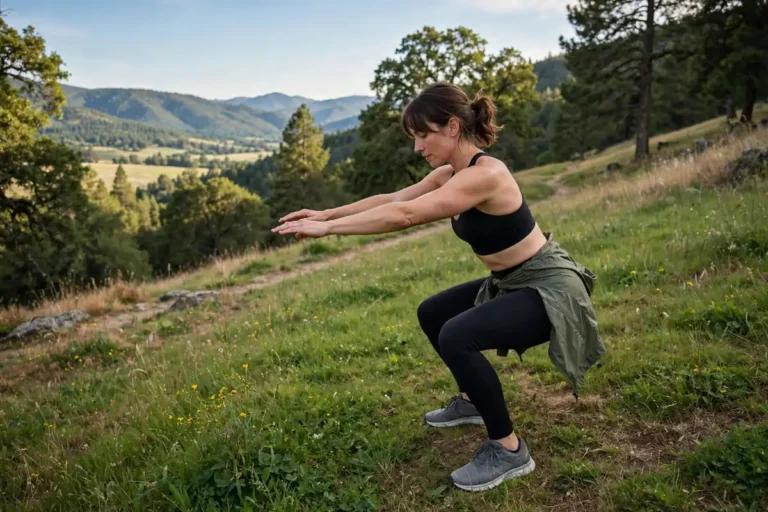
What Makes a Warm-Up Different From Static Stretching

A warm-up raises your heart rate and rehearses the movement you’re about to do; static stretching holds a muscle at length while you’re still. Both have a place in a workout, but doing them at the wrong time is the mistake most people make.
Why a warm-up vs static stretching order matters
A warm-up is built from movement — a few minutes of easy cardio followed by dynamic drills like leg swings, walking lunges, or arm circles that move your joints through the same range they’ll use in the workout ahead. It raises muscle temperature, increases blood flow, and cues your nervous system for what’s coming. That combination is what actually prepares tissue to work hard, not the stretch itself.
Static stretching is different: you move into a position, like a standing hamstring stretch, and hold it without motion for twenty to sixty seconds. Held long enough, it can temporarily reduce how much force a muscle can produce right afterward. Doing a long static stretch on a cold muscle right before heavy squats or sprinting isn’t dangerous, but it can leave you feeling looser without leaving you any stronger for the work ahead.
Where each one fits in a session
Save static stretching for after the workout, or for a separate session focused on flexibility, when the muscle is already warm and you’re not about to load it heavily. Before training, favor movement-based warm-ups that mimic what you’re about to do, along the lines covered in a full warm-up routine: a few bodyweight squats before a squat session, an easy jog before a run, arm circles and light rows before an upper-body day. The National Academy of Sports Medicine covers this movement-first approach to preparing muscles and joints for training in more depth.
People coming back from a break from regular training often skip the warm-up entirely because it feels like wasted time before the real workout starts. It isn’t. A five-minute warm-up is part of the session, not a delay before it, and it’s one of the simplest ways to reduce how rough the first few sets feel.
If you’re working around an old joint issue or recovering from an injury, a physical therapist can suggest specific warm-up drills for that area rather than a generic routine, since some joints need more preparation time than others.
Next time you train, try running your warm-up and stretching in that order — movement first, static holds after — and pay attention to whether the first working set feels less stiff than usual. That’s the whole test.
What a Warm-Up Actually Does Inside Your Body
A warm-up is not just a polite beginning to a workout. It triggers a set of physical changes that make everything after it safer and more effective. As you move at an easy intensity for a few minutes, your heart rate rises and blood flow to the working muscles increases, delivering more oxygen where it is about to be needed. Your muscle temperature climbs, which makes the tissue more elastic and responsive, and the fluid inside your joints thins out, so knees, hips, and shoulders move more smoothly. Your nervous system wakes up too: the communication between brain and muscles sharpens, so coordination and reaction time improve before any real load arrives.
This is fundamentally different from what static stretching does. Holding a stretch lengthens a muscle passively while your body stays still. It does not raise your heart rate, warm your tissues, or rehearse the movement patterns you are about to perform. That is why research has repeatedly found that a dynamic warm-up, easy movement that gradually builds intensity, improves performance on strength and power tasks, while long static holds right before training can temporarily reduce force and power output. For a look at what those first minutes of activity do moment by moment, see our article on what happens to your body in a workout’s first ten minutes.
Static Stretching After the Workout: How to Do It Right
Static stretching is not the enemy. It is simply a tool for a different job: improving flexibility, easing post-workout tightness, and helping you wind down. After a workout, your muscles are warm and pliable, which makes it the best time for static work. The evidence supports using it regularly for flexibility, two or three times per week at minimum, even in short five-to-ten-minute sessions.
How long to hold each stretch
For general flexibility, holding each stretch for about 30 seconds is the standard recommendation, and Mayo Clinic’s guide on stretching safely suggests extending to around 60 seconds in problem areas. Breathe normally while you hold, and never bounce. Bouncing, sometimes called ballistic stretching, can injure the muscle and actually increase tightness. Stretch to the point of gentle tension, not pain. If it hurts, you have gone too far, so back off until the tension feels manageable and hold there.
A simple post-workout stretching routine
You do not need a long yoga sequence. After your workout, pick four to six stretches covering the areas you trained: calves against a wall, a standing quad stretch holding a support for balance, a seated or standing hamstring stretch, a chest opener in a doorway, and a gentle neck and shoulder stretch. Hold each for 30 seconds per side, breathe slowly, and finish in under ten minutes. Focus on the major muscle groups and any area that feels tight, and stretch both sides evenly, since flexibility that is lopsided can be a risk factor for injury.
A 5-Minute Dynamic Warm-Up You Can Use Every Day
A good warm-up needs no equipment and barely any time. Five to ten minutes of dynamic movement is enough for most workouts, and the exact routine should mimic what you are about to do. Here is a simple full-body sequence that works before almost any session: start with one minute of easy marching in place or a light jog to raise your heart rate. Then do 10 leg swings per leg, front to back, holding a wall for balance. Follow with 10 arm circles each direction, gradually making them bigger. Then 10 bodyweight squats at an easy depth, 10 walking lunges with a gentle torso twist, and finish with 10 hip circles each direction. Move continuously and with control, never forcing range of motion.
If your workout is lower-body focused, spend extra time on the hips and ankles. If it is upper-body focused, add band pull-aparts or easy push-ups against a wall. The principle is the same either way: start general, get specific, and finish with a rehearsal of the movements you are about to load. Our detailed guide on how to warm up before a workout walks through workout-specific warm-up structures if you want to go deeper.
Frequently Asked Questions
Should I ever do static stretching before a workout?
Short holds under 30 seconds as part of a broader warm-up are generally fine, especially for a muscle that feels unusually tight. What the research warns against is long static holds, a minute or more per stretch, right before strength or power work, since those can temporarily reduce performance. Keep pre-workout static work brief and follow it with dynamic movement.
How long should a warm-up be?
Five to ten minutes of dynamic movement is enough for most workouts. Longer or more intense sessions, cold weather, or early-morning training may call for a few extra minutes. The warm-up is done when your heart rate is up, your joints feel loose, and you have rehearsed the key movements lightly.
Is stretching after a workout necessary?
It is not strictly necessary for everyone, but it is a good habit. Regular post-workout stretching supports flexibility and range of motion over time, and many people find it helps them wind down and feel less stiff the next day. Even five minutes, two or three times a week, delivers most of the benefit.
What is the difference between dynamic and static stretching?
Dynamic stretching uses controlled movement to take joints through their range of motion, like leg swings or walking lunges. Static stretching holds a muscle in a lengthened position while you stay still, like touching your toes and holding. Dynamic work suits warm-ups; static work suits cooldowns and dedicated flexibility sessions.
Can I skip the warm-up if I am short on time?
You can shorten it, but do not skip it entirely. Even two to three minutes of easy movement, a brisk walk, some arm circles and bodyweight squats, is far better than jumping straight into heavy work cold. If time is truly tight, cut a set from the workout rather than the warm-up.
Conclusion
A warm-up and static stretching are not rivals; they are tools for different moments. Dynamic movement before training prepares your body to perform, raising blood flow, temperature, and coordination. Static stretching after training, or as its own session, builds and maintains flexibility when your muscles are warm and receptive. Put each in its proper place, keep the warm-up to five or ten minutes and the stretches to 30-second holds, and both jobs get done. For more practical training guidance, browse All Day Health & Fitness.