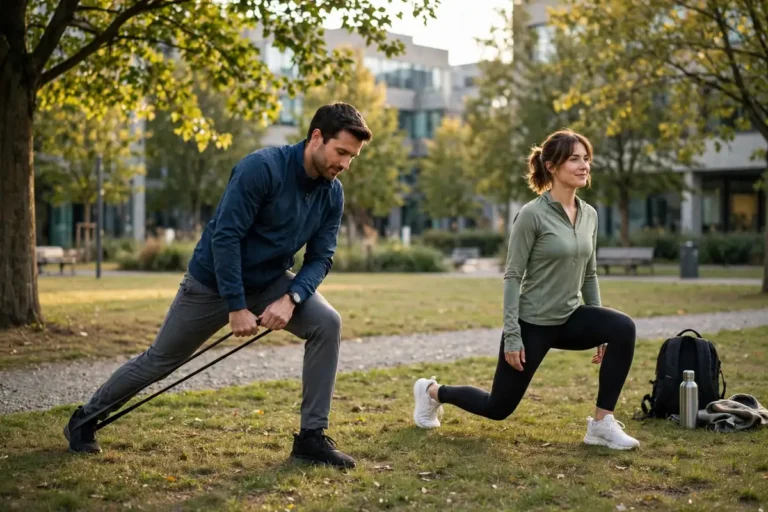
What Makes a Workout Buddy Help With Consistency

A workout buddy helps with consistency mainly because it turns a private intention into a small social commitment: skipping means letting someone else down, not just yourself. That effect is real, but it depends on choosing the right person and setting things up so the partnership doesn’t become one more plan to cancel.
Why workout buddy accountability works
Most people don’t drop an exercise routine because they stop believing it’s good for them. They drop it because, on a given evening, the sofa wins. A fixed appointment with another person shifts that moment. You’ve already decided; you’re just keeping a promise.
Social support from friends, family or a group is one of the factors most consistently linked with people staying active over time. Company also changes how a session feels. Conversation makes easy efforts pass faster, and a partner can notice when your form slips or when you’re pushing too hard on a day you should be easing off. For a sense of how much weekly activity to aim for and the types that count, the NHS exercise guidance is a clear reference to share with a partner.
If you’re weighing this against other formats, our comparison of group classes and solo workouts covers what each offers for structure and motivation.
Choosing the right partner
The best partner isn’t necessarily your fittest friend. What matters more:
- Similar schedules. If one of you works shifts and the other doesn’t, sessions will keep getting moved until they stop happening.
- A workable pace for both. You don’t need to be at the same level, but the activity should suit both of you. Brisk walks, a mixed-level class, or strength training where each person picks their own load all handle differences well.
- Reliability over enthusiasm. Someone who commits to twice a week and turns up is more useful than someone who wants to train every day for a fortnight and then vanishes.
- No scorekeeping. A buddy who turns every session into a competition, or comments on how anyone’s body looks, makes it harder to keep going. The point is to support each other’s energy, strength and routine.
Setting it up so it lasts
Agree on a specific day, time and place, and put it in both calendars. Decide in advance what happens when one person can’t make it: does the other go alone, or do you reschedule within the same week? Having that answer ready stops a single cancellation from quietly ending the arrangement.
Keep sessions modest, too. A plan you can both manage on a tired day will outlast an ambitious one. Our guide to building an exercise habit that sticks goes deeper on sizing a routine realistically.
And expect the partnership to change. People move, change jobs or pick up new commitments. A good buddy arrangement carries you through the early weeks when a habit is most fragile; by the time it ends, you may find you’re showing up on your own. If either of you has a health condition or is returning from an injury, check with a doctor or physiotherapist about what kind of activity suits you before you start.
This week, send one message: name a day, a time and a single activity, and ask one person if they’re in.
Why Accountability Changes the Math of Skipping
Skipping a solo workout costs you nothing socially. Nobody knows. Nobody is waiting. Nobody asks where you were. That is exactly why it is so easy. A workout buddy changes the equation by attaching a small social cost to skipping: someone else showed up, or at least expected you to. You are no longer negotiating with your own tired brain at 6 a.m. You made a promise to a person, and most people keep promises to others more reliably than promises to themselves.
This is not about shame. It is about how motivation actually works. Motivation is unreliable fuel on its own, rising and falling with mood, sleep, and weather. Accountability is a different system entirely: it keeps the sessions happening during the low-motivation weeks, which are the weeks that determine whether a habit survives. The CDC itself lists social supports, including buddy systems, among the key strategies for maintaining and increasing physical activity.
It Is the Support, Not Just the Schedule
Research on exercise companions has found something worth knowing: finding a new exercise partner does increase how much people exercise, but the kind of support matters. In a University of Aberdeen study, participants who found a new gym buddy exercised more than those who stuck with their normal routine, and the effect was strongest when the partner offered emotional support and encouragement rather than just practical help. In other words, the buddy who cheers you on beats the buddy who merely drives you there.
This has practical implications for choosing a partner. Do not pick the fittest person you know. Pick someone reliable, encouraging, and roughly at your level, so neither of you is constantly waiting or constantly being dragged. Agree on the basics up front: which days, what time, what you will do, and what happens when one of you cannot make it. A partnership with no plan is just a friendship that occasionally mentions exercise.
Virtual accountability can work too. Research from Michigan State found that even a virtual exercise partner could motivate people to extend their workouts. Check-ins by text, shared training logs, or a standing weekly call all count. The mechanism is the same: someone else is paying attention to whether you did the thing. If no local friend fits, an online training group or a group class can provide the same social structure. Our comparison of group classes and solo workouts can help you decide which social format suits you.
How to Be a Good Workout Buddy (So They Stay Yours)
Accountability partnerships die from the same causes: one person flakes, the other feels used, resentment builds. Protect yours with a few rules. First, treat sessions like appointments you cannot casually cancel. One reschedule is life. Three in a row is the partnership dissolving.
Second, be encouraging, not competitive. The Aberdeen finding is your guide: praise and encouragement outperform everything else. Celebrate your partner’s consistency, not just their performance. The moment workouts become a contest, the weaker partner starts dreading them.
Third, have a backup plan for solo days. There will be weeks when schedules do not align. Agree in advance that you each train alone rather than skipping, and check in afterward. A partnership that survives apart is stronger than one that only exists together. This pairs well with the habit systems in our guide on building an exercise habit that sticks: the buddy is the scaffold, and the habit is the building.
Frequently Asked Questions
What if I cannot find anyone to work out with?
You have options: group classes, running or lifting clubs, online accountability groups, or even a standing check-in with a friend who trains separately. The core ingredient is a regular, expected report to another person, not physical proximity.
Should my workout buddy be at my fitness level?
Roughly, yes. Similar levels mean similar session lengths and intensities, so neither person is compromising. A big gap can still work if you are both flexible, but matching levels removes the most common source of friction.
How do I end a workout partnership that is not working?
Honestly and kindly. Say your schedule or goals have changed and you need to train differently for a while. Do not ghost, because the same social pressure that made skipping hard will make an awkward silence worse. Most people understand.
Can a personal trainer serve as my accountability partner?
Yes, and for some people it is the most reliable version. A trainer provides scheduled sessions, professional guidance, and a strong financial reason not to cancel. The emotional-support finding still applies: a trainer who encourages you will keep you longer than one who only criticizes.
Does accountability work for diet too?
The same principle applies: regular check-ins with another person make it harder to quietly abandon a plan. Many people pair a training buddy with a nutrition check-in, whether with the same person or a different one.
Conclusion
A workout buddy works because it turns a private intention into a social commitment, and because encouragement from another person sustains effort better than willpower alone. Choose someone reliable and encouraging, agree on a simple plan, and treat your sessions like appointments. The research is unusually consistent on this one: people who exercise with supportive partners exercise more. ScienceDaily’s summary of the Aberdeen study is a good starting point if you want the details: a new exercise partner is the key to exercising more. For more ways to make consistency automatic, explore the All Day Health and Fitness guides.