What SPF Numbers Actually Mean
SPF stands for Sun Protection Factor, and the number measures how much longer a sunscreen lets you stay in the sun before UVB rays start to redden your skin, compared with wearing no protection at all. It does not measure how strong or thick the protection is — it measures time, and only for one type of ray.
What the number is comparing
An SPF 30 sunscreen, used correctly, filters out roughly 97% of UVB rays; SPF 50 filters out about 98%. That jump from 30 to 50 looks bigger on the label than it is in practice — the real difference in protection is small, while how thickly and how often either one gets applied usually matters more than the number itself. No sunscreen blocks every UV ray, regardless of what’s printed on the bottle.
UVB is only part of the picture
SPF numbers say nothing about UVA protection, which penetrates deeper into skin and is linked to long-term skin aging and skin cancer risk. Look for “broad spectrum” on the label — that’s the term that tells you a product covers both UVA and UVB, not the SPF number alone. Broad-spectrum claims are tested and regulated separately from the SPF rating.
Why the habit matters more than the number
- Sunscreen applied too thin performs closer to half its labeled SPF
- Reapplication matters more than the starting number — sweat, swimming, and toweling off all reduce coverage
- Most people apply well under the amount used in SPF testing labs
- A lower SPF applied generously and reapplied often can outperform a high SPF applied once and thinly
Clothing, shade, and avoiding peak UV hours all work alongside sunscreen rather than instead of it, and none of them depends on reading a label correctly to help.
What to do with this at the checkout
Pick a broad-spectrum sunscreen of SPF 30 or higher, whichever texture you’ll reliably reapply without avoiding it, and treat the reapplication reminder as more important than chasing a bigger number. For more on choosing and applying sunscreen correctly, the American Academy of Dermatology’s sunscreen FAQ is a good next read. Anyone with a history of skin cancer, unusual moles, or a reaction to a specific sunscreen ingredient should get personalized advice from a dermatologist rather than choosing based on packaging alone.
Why SPF Is Not a Percentage
The most common mix-up about SPF is treating the number like a percentage. It is not. SPF, or sun protection factor, measures protection against UVB rays, the rays that burn skin. The number describes how much solar energy it takes to cause a sunburn with the sunscreen on compared with bare skin: SPF 30 means roughly 30 times as much UV exposure is needed to burn.
The percentages come from a separate calculation, and they hold a surprise. SPF 15 filters about 93 percent of UVB rays, SPF 30 about 97 percent, SPF 50 about 98 percent, and SPF 100 about 99 percent. The leap from 30 to 100 looks dramatic on the bottle but amounts to roughly two percentage points of extra UVB blocked. And no sunscreen, at any number, blocks 100 percent of UV rays.
The Diminishing Returns of Very High Numbers
This is why dermatologists rarely get excited about SPF 100. A higher number offers a small extra margin, useful for fair skin or long hours in strong sun, but it can also create a false sense of armor. Research has repeatedly found that people wearing higher SPF numbers stay out longer and reapply less, wiping out the small advantage the number gave them. The number helps, but behavior helps more.
SPF Measures Solar Energy, Not Minutes
Another widespread belief is that SPF is a timer: burn in ten minutes unprotected, get 300 minutes from SPF 30. The FDA is clear this is not how it works. SPF measures solar energy, not clock time, and solar energy shifts constantly. Skin receives far more UV energy in fifteen minutes of midday sun than in an hour of early morning light, and altitude, latitude, clouds, and reflection off water or sand all change the dose.
That is the practical reason every authority repeats the two-hour rule. Whatever the number on the bottle, sunscreen needs reapplying at least every two hours outdoors, and sooner after swimming or sweating. Reapplying does not restart a timer; it simply replaces the layer that rubbed, sweated, or washed off.
SPF Only Covers UVB, So Read the Rest of the Label
SPF says nothing about UVA, the rays that penetrate deeper, drive premature aging, and contribute to skin cancer. That second half of protection comes from the words broad spectrum. A sunscreen can read SPF 50 and still be weak against UVA without it. Under FDA labeling rules, only products that pass testing for both UVA and UVB may claim broad spectrum, and only broad-spectrum SPF 15+ products may claim to help reduce skin cancer and early aging risk. The filter type behind the number, chemical or mineral, does not change what SPF means, but it changes how the formula feels and behaves. Our guide to chemical vs mineral sunscreen covers those differences.
Getting the Number You Paid For
Here is the uncomfortable truth behind most sunscreen disappointment: the SPF number was earned in a lab, with far more product applied than most people use in real life. Testing uses about two milligrams per square centimeter, roughly one ounce, a shot glass full, for the whole body. Most people apply a quarter to half of that, so the SPF 50 on their skin performs like something much lower. A generous layer of SPF 30 genuinely outperforms a skimpy layer of SPF 100.
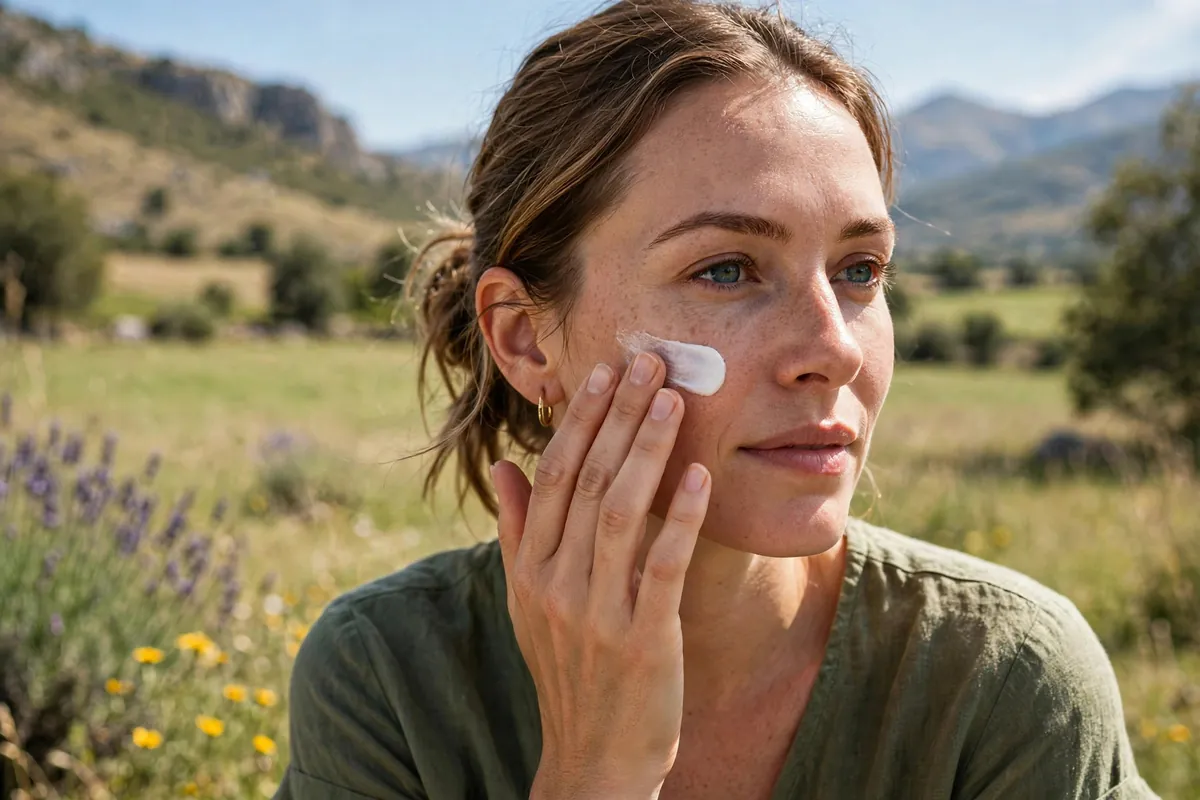
For the face, most dermatologists suggest about a nickel-sized dollop, applied fifteen minutes before exposure so it forms an even film. Skimpy application is the single most common sunscreen mistake; our breakdown of applying sunscreen too thin shows exactly where coverage falls short. The FDA’s consumer guidance says the same: broad spectrum, SPF 15 or higher, a full ounce for the body, reapplication every two hours, because no sunscreen blocks UV completely alone. See their guide to sunscreen for details.
Choosing Your Number Without Overthinking It
The decision is simpler than the aisle suggests. The American Academy of Dermatology recommends broad-spectrum, water-resistant SPF 30 or higher for daily use, which suits most people on ordinary days. Step up to SPF 50 for fair, burn-prone skin or intense exposure like hiking or beach days. Above 50 is fine if it gives you confidence, just do not let the number talk you out of reapplying or seeking shade. Sunscreen is also one layer among several: hats, sunglasses, and protective clothing do work no bottle can. For more plain-language skincare guides, browse the All Day Health & Fitness homepage.
Frequently Asked Questions
Is SPF 100 twice as protective as SPF 50?
No. SPF 50 blocks about 98 percent of UVB and SPF 100 about 99 percent. Real-world protection depends far more on applying enough and reapplying on time.
Does a higher SPF mean I can stay out longer?
Not the way most people assume. SPF is not a countdown timer, UV intensity changes through the day, and sunscreen wears off. Reapply every two hours regardless of the number.
Does SPF protect against UVA rays?
Not by itself. SPF measures UVB only. Look for the words broad spectrum, which indicate the product passed testing for both UVA and UVB.
Should I wear SPF 30+ daily or only at the beach?
Daily on exposed skin, as the final step of your morning skin care routine. UV passes through clouds and windows, and incidental exposure accumulates over the years. Daily broad-spectrum SPF 30 is the standard dermatologist recommendation.
Can the SPF in my moisturizer replace sunscreen?
It helps, but only if you apply enough. Most people use far less foundation or moisturizer than the tested amount, so the labeled SPF is rarely achieved. A dedicated sunscreen underneath is the safer bet.
Conclusion
SPF numbers are simpler than they look: protection against UVB, expressed as a multiple of solar energy, not a percentage and not a timer. SPF 30 broad spectrum, applied generously and reapplied every two hours, delivers the vast majority of what any sunscreen can do. Pick a formula you will actually wear daily, because the best SPF number is the one that makes it onto your skin.